
A course from a QA expert with experience working at the Dutch Ministry
Tester from scratch to Junior
Full immersion: from websites to neural networks
In 3 months, you will have a profession for which international companies pay from €2000
Let's get acquainted
120+
Students
500+
Bugs Found
14 years old
the youngest student
66 years old
the oldest student
Who is a tester (QA engineer)?

A tester is a specialist who checks websites, applications, and programs and evaluates LLM models for errors and inaccuracies. They record any defects in a report for the developers so they can fix them and release a high-quality product.
Find out if being a tester is right for you
Decent pay
The starting salary for a Junior QA is around €2000. After three years, it can rise to €3,000 or more. With experience, you can explore related fields with even higher pay.
Easy start
You can get into testing from any profession. No programming knowledge or perfect English required. Age is not a barrier. The main thing is to be good with computers.
Remote format
Remote work is normal for QA engineers. Yes, yes, no traffic jams, no dress code, and no time wasted on commuting. In your own home, in your favorite chair with a cup of tea and a cat on your lap.
Demand
The number of websites and apps is constantly growing, and all of them need to be tested. Even artificial intelligence is not a competitor to QA engineers, but their client! So there’s plenty of work for the mind!
What students say
★★★★★
"Thanks to the knowledge I gained, after just 2 months I was able to apply for a major project"
Darina Daems
★★★★★
"The logical sequence of topics gives the feeling of gradually immersing into a new field for myself"
Alexander Opanasenko
★★★★★
"Thanks to Qoolli, I gained a new profession, new opportunities, and confidence in my abilities"
Inna

Key points about the course
-
The course duration is 3 months.
-
The program includes 11 modules, each with 5–7 video lessons.
-
Practical homework assignments after each module.
-
Certificate awarded after passing the exam.
-
Language: Russian. Ukrainian, Dutch, if a group is formed
Course program
I included only what is actually useful for work in the course.
The program is constantly updated so that you become a pro and meet the IT market demands.
Modules
Module 0. QA Testing: Starting Point
- You get an understanding of how the training is organized, the lesson schedule, and homework. You know what and when to do to achieve the result.
- You get acquainted with the main set of QA engineer tools: Jira, IDE, Git, Postman, JMeter, Gemini, Chat GPT, Chrome DevTools, OWASP ZAP, Git, Claude, and Browserstack.
- You understand the role of a tester and their tasks within a team, so you can confidently integrate into the workflow of any IT company.
- You clearly see how to find and properly document bugs in Jira.
- You learn what results to expect at the end of the training and how to use them for confident employment.
Module 1. Testing Theory. Defect Life Cycle DLC
-
You can distinguish verification from validation. You understand the goals and the necessity of testing.
-
You understand the concepts of “bug”, “defect”, and “failure”, study the levels and types of testing, as well as the 7 fundamental principles of ISTQB.
- You find bugs and create clear bug reports with correct Severity and Priority, after which developers do not ask unnecessary questions.
-
You know how to conduct exploratory testing and test tours, quickly mastering any new product without ready-made instructions or documentation.
- You set up your LinkedIn profile with your first position as a student, laying the foundation for your reputation in the global IT community.
Module 2. Test Design. Working with AI tools. Checklist
- You will get a strategy for analyzing a new product. You will learn to perform model-based testing, consider product risks, and generate tests based on them.
- You can create checklists with the help of AI to cover business-critical scenarios in minimal time.
- You will master Black-box techniques (testing without code knowledge) and Equivalence Partitioning (data grouping), saving time on testing.
- You apply BVA (Boundary Value Analysis), checking the edge values of the system where critical failures most often occur.
Module 3. Web Project Testing. Test Plan
- You create a Test Plan (work plan) and understand STLC (testing lifecycle) to clearly plan the testing of any project.
- You test the layout according to a checklist across different browsers and smartphones, ensuring perfect display of the website for every user.
- You master Browser Dev Tools (developer panel) and simulators to find hidden errors in the code and browser console.
- You understand SDLC (development cycles), knowing the team’s workflow and your role at each stage of product creation.
- You read HTML/CSS code and data formats JSON/XML to understand the structure of a web page and quickly find bugs in it.
Module 4. Mobile Application Testing. Test Case
- You study types of mobile platforms and applications, understanding their differences and installation specifics.
- You get familiar with working on builds (program assemblies) and learn the stages of mobile application testing.
- You understand how to test applications before publishing them on the App Store and Google Play.
- You create and work with Test Cases (detailed verification scenarios), knowing their structure, purpose, and rules for writing quality tests.
- You conduct mobile software testing using checklists and professional tools.
- You master BrowserStack (a service with real devices) for remote testing of applications on any smartphones and tablets.
Module 5. Performance Testing
- You get acquainted with types of performance testing, load scenarios for a website or application, and the principles of how websites work.
- You understand client-server architecture and HTTP requests (the connection between a website and the server), comprehending the logic of system responses.
- You install and configure JMeter – a tool for load testing.
- You create test scenarios for load testing, analyze metrics, and compile reports, understanding what needs to be fixed.
- You will learn to install Java (for working with JMeter) and use CMD (Windows command line) and Terminal (Mac/Linux command line).
Module 6. Security Testing. API Testing. Collections
- You study the basic principles of cybersecurity and the causes of vulnerabilities in systems and web applications.
- You gain a deep understanding of a tester’s strategy when building a secure system.
- You conduct cybersecurity tests using a checklist, identifying vulnerabilities and protecting the product from hacks and data leaks.
- You work with Postman and Swagger: you create API requests, verify responses, and analyze data.
- You learn MySQL databases and the SQL language to work directly with data and verify its integrity within the system.
Module 7. Game Testing
- You understand what a game domain is and take its specifics into account during testing.
- You gain practical insight into industry requirements and the skills needed for a QA specialist in game development.
- You know what issues games face across different platforms and devices.
- You learn to test game mechanics, levels and quests, UI and controls, localization and cultural compliance, etc.
- You know how to properly write bug reports with reproduction steps, screenshots, and videos.
Module 8. Testing applications with built-in artificial intelligence (AI)
- You study AI and understand how testing it differs from testing traditional software.
- You can identify the role of AI in a product: CV (computer vision), NLP (text processing), or generation, choosing the best strategy to test the system.
- You master modern methods of testing LLMs used when there is no reference (ground-truth) answer.
- You evaluate AI quality using metrics such as F1 Score (answer accuracy).
- You develop a systematic understanding of the QA role in AI projects as an analyst, researcher, and guardian of user experience.
Module 9. Automated testing: Selenium / Java / Git
- You understand why test automation is needed and in which cases it is effective.
- You get familiar with Selenium WebDriver — the main tool for automating web applications.
- You learn the basic syntax of Java (a programming language) and how to apply it to writing automated tests.
- You are able to create and run automated tests, as well as analyze their results.
- You learn Git (a code repository system), how to make commits (save changes), and how to work with branches for collaborative automated test development.
Module 10. Working in an IT company. Agile
- You learn Agile — a flexible development approach where work is done in short iterations with continuous feedback.
- You study the Scrum methodology: User Story (task description), Backlog (list of tasks), Sprint (short work cycle).
- You get familiar with the concepts of Daily Scrum (short meetings) and Scrum Board (task board).
- You learn how Sprint Retrospective (review of results) is conducted to improve workflows and increase personal effectiveness in IT.
Course features that you will appreciate
The first module is free
You will get acquainted with the profession, see the learning format, and calmly decide whether you want to continue the course.
Flexible payment
If your budget is limited, the course can be paid in 3 installments — you complete the training while paying gradually.
Flexible schedule
Each module takes one week. When you watch the lessons and complete the assignments is up to you, allowing you to fit your studies around your life.
Instructor support
A weekly group call for those who have questions, plus unlimited personal consultations with the instructor.
Lifetime access to materials
All course materials — video lectures and presentations — remain yours forever. You can refresh your knowledge at any time.
Toolkit
You receive a set of checklists, templates, and instructions that save time in real-world testing work.
Turnkey packaging
You receive everything you need to start your career: a CV, a LinkedIn profile, a recommendation letter, and a training certificate.
Interview rehearsal
I ask questions as a hiring manager, you answer, then we review mistakes. You confidently go into a real interview.
We hire you
The best graduates are added to a talent pool to work on real commercial projects.
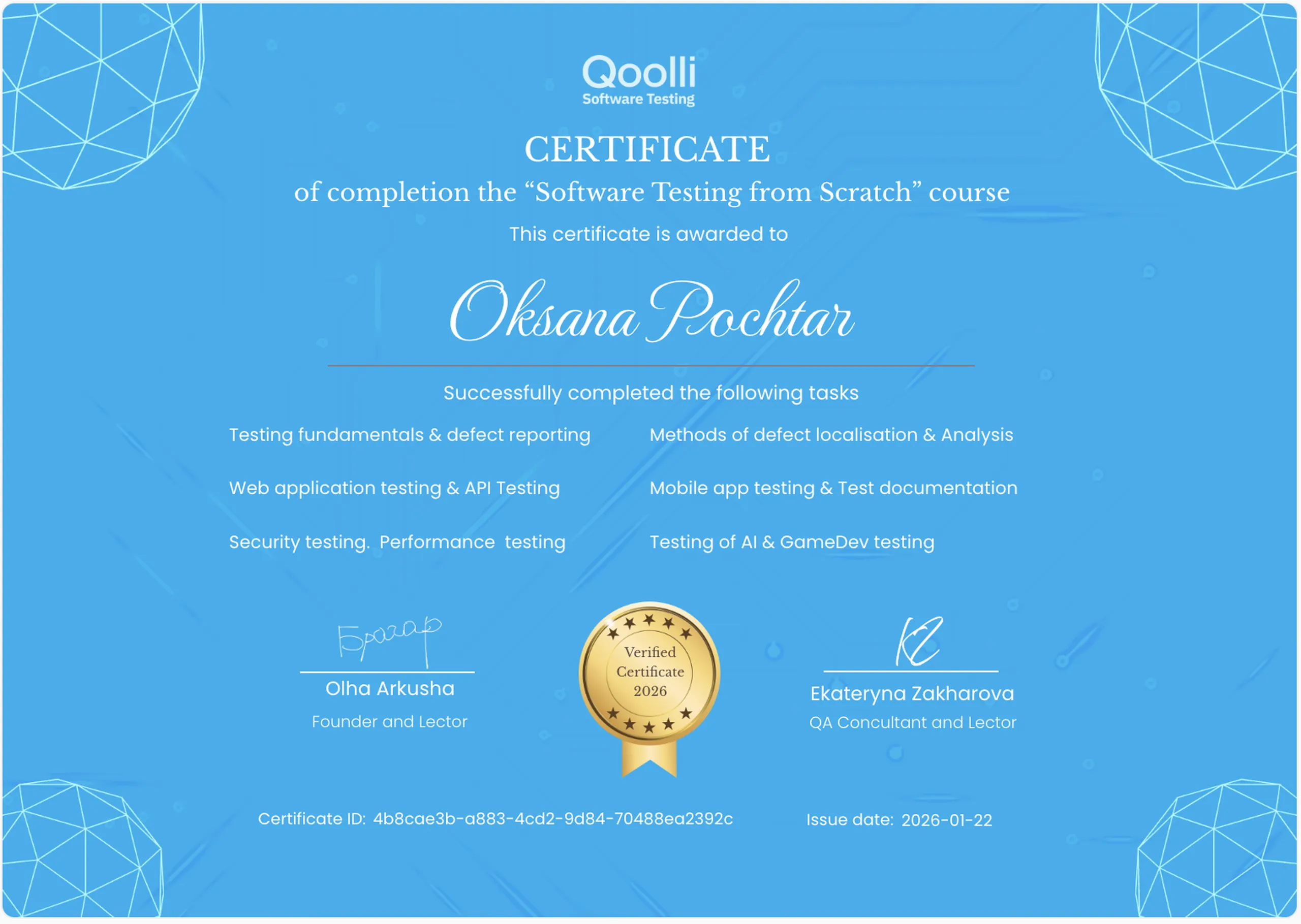
Digital certificate
- is issued on Certifier — a reputable independent platform used by Amazon, Volvo, Warner Bros., University of Birmingham, and Duolingo
- is stored almost indefinitely
- impossible to forge
- you can share the link on LinkedIn, X, Facebook, and other platforms
You receive the certificate after completing all homework assignments and passing the exam.
Your skills in the CV

Key skills
- Manual testing (Web, Mobile, Games)
- Test design techniques: Equivalence Partitioning, Boundary Value Analysis, Exploratory Testing
- API testing (REST)
- Test documentation, DLC: test cases, test plans, checklists, bug reports
- Mobile testing: Android and iOS (native, hybrid, and web applications)
- Performance testing: Load, Stress, Spike testing, Breakpoint testing, Endurance testing, scalability test planning
- Security testing: IDOR, XSS, CSRF, SQL Injection
- AI application testing and LLM model evaluation
- Test automation: Selenium WebDriver, Page Object Model
- SDLC, STLC, and Agile methodologies
Technical skills
- Tools: JIRA, Postman, Swagger, Chrome DevTools, Apache JMeter, BrowserStack, Git
- Technologies: REST API, HTML/CSS/JS, SQL, MySQL
- Automation: Selenium WebDriver, Java (basic level)
- AI tools: ChatGPT, Perplexity, Gemini, DeepSeek, Claude for test design and analytics
You can immediately post your CV on job search websites. You will also learn how to use AI to tailor it for specific job openings, helping you stand out as a beginner and find a job faster.

Tester’s toolkit
- Proprietary checklists (usually not provided in courses) for testing UI/UX, mobile applications, AI security, etc. + videos on how to apply them in practice.
- A test plan template and a guide on how to fill it out, so you know how to organize the process in any project.
- Examples of test cases and a guide on how to fill them out for a professional description of work tasks.
- A set of AI prompts that speed up documentation writing several times.
- Links to job search platforms, instructions for creating profiles, and job placement advice.
- A list of English words needed for a tester, along with links to reliable resources for learning the language.
Tester’s toolkit
- Proprietary checklists (usually not provided in courses) for testing UI/UX, mobile applications, AI security, etc. + videos on how to apply them in practice.
- A test plan template and a guide on how to fill it out, so you know how to organize the process in any project.
- Examples of test cases and a guide on how to fill them out for a professional description of work tasks.
- A set of AI prompts that speed up documentation writing several times.
- Links to job search platforms, instructions for creating profiles, and job placement advice.
- A list of English words needed for a tester, along with links to reliable resources for learning the language.
Instructor Olha Arkusha
- founder of Qoolli Academy
- certified ISTQB QA specialist with 9 years of experience
- tested software at the Ministry of Foreign Affairs of the Netherlands
- QA mentor
- worked in the following domains: PropTech, TravelTech, MobilityTech, FinTech, payment system testing, HealthTech, GiftTech, FoodTech, SportTech; was an administrator of cloud services (Google Workspace, Jira, Slack)
- author of a Telegram channel for beginner testers


Instructor Kateryna Zakharova
- co-author of the course
- certified ISTQB QA specialist with 7+ years of experience in IT
- QA Automation Engineer (Selenium + TestNG + Java)
- tested AI and ML projects
- worked in the following domains: FinTech, fraud detection (cybersecurity), GameDev
- mentor for junior QA engineers and teams
Instructor Olha Arkusha
- founder of Qoolli Academy
- certified ISTQB QA specialist with 9 years of experience
- tested software at the Ministry of Foreign Affairs of the Netherlands
- QA mentor
- worked in the following domains: PropTech, TravelTech, MobilityTech, FinTech, payment system testing, HealthTech, GiftTech, FoodTech, SportTech; was an administrator of cloud services (Google Workspace, Jira, Slack)
- author of a Telegram channel for beginner testers
Instructor Kateryna Zakharova
- co-author of the course
- certified ISTQB QA specialist with 7+ years of experience in IT
- QA Automation Engineer (Selenium + TestNG + Java)
- tested AI and ML projects
- worked in the following domains: FinTech, fraud detection (cybersecurity), GameDev
- mentor for junior QA engineers and teams
Student testimonials
Darina Daems
In 2 months, I gained an understanding of testing and can perform simple tasks at a beginner level. It is inspiring because I can see the results of my efforts.
Andrey Cherkassov
I liked the feedback system. Assignments are carefully reviewed, and constructive advice is given on what and how to improve. You can feel that each student receives attention.
Alexander Opanasenko
There were moments when I didn’t understand something right away. But whenever difficulties arose, Olga and her team were always available. They either explained things personally or held additional group Q&A sessions. This level of support means a lot.
Training cost
Take the free introductory module.
You only pay for the course if you decide to continue your studies.
Full price
680€
The course can be paid in installments:
230 € – Модули 1–4
230 € – Модули 5–8
220 € – Модули 9, 10
If you pay for the course in a single payment, you receive a 10% discount
You deposit 612 €, you save 68 €.
The training pays off from the very first salary of a Junior QA tester!
Doubting you’ll succeed?
Fear exists where there is no support. But that’s not about us! We are always here and will help you figure everything out.
In addition, your success is personally beneficial to me. First, successful students are my reputation. Second, I need well-prepared specialists for projects.
Any questions left? Write “consultation” during registration.
I will contact you to personally go through all the details in 30 minutes.
What is usually asked before starting
What kind of computer is needed for studying?
Minimum requirements: Intel i5-14400U / i5-14500U processor or AMD Ryzen 5 764U / Ryzen 7 784U; RAM — 16 GB; storage — 256 GB SSD.
What level of computer skills is required?
A basic user level is required: the ability to click, search, install programs, and not be afraid of settings.
How well do you need to know English?
A “dictionary level” is acceptable. In the process, you will quickly learn basic IT terms — this is enough to start working.
How much time should you dedicate to studying?
About 12–15 hours per week: 2–3 hours for theory and 8 hours for practice. Around 40 hours per month. The exam lasts 1 hour, and preparation takes about 5–8 hours. This is a minimum estimate — in practice, it may take more time.
What kind of people feel comfortable working as a tester?
For those who are a natural-born inspector and love finding mistakes. And who are also patient, detail-oriented, and curious.
What should I do if I won’t manage to complete my homework on time?
Don’t worry about it. Just let us know your situation, and we will find the best solution.
What should I do if I won’t be able to make the second or third payment on time?
No problem. After payment, you will be able to continue your studies with the next group from where you left off.
Can I start looking for a tester job right after the course?
Of course! With your knowledge, portfolio, and CV, you can confidently apply for Junior QA positions right after the exam.
Course registration
Enter your details
KVK-nummer 99610221 | BTW id NL005398731B55 | Ob Nummer 680952184B01